
Troop 143 - Gainesville, Texas
Troop 143 - Gainesville, Texas
The Tenderfoot rank is an essential early step on the journey to becoming a skilled Scout within Scouting America. It serves as the starting point where Scouts begin to immerse themselves in the fundamental skills and knowledge that are core to the Scouting experience.
One of the main focuses during the pursuit of the Tenderfoot rank is learning the basics of camping. Scouts will gain valuable insights into setting up a campsite, understanding the importance of Leave No Trace principles, and engaging with nature responsibly. These experiences foster a sense of adventure and an appreciation for the outdoors.
In addition to camping, the Tenderfoot rank emphasizes the importance of first aid. Scouts will learn critical skills that can help them respond effectively in emergencies, such as treating minor injuries and understanding the basics of first aid kits. This knowledge not only enhances their safety but also promotes a sense of responsibility for the well-being of themselves and their peers.
Teamwork is another fundamental aspect of the Tenderfoot rank. Through various activities and challenges, Scouts develop the ability to work collaboratively with others. This experience not only builds friendships but also instills values of leadership, communication, and problem-solving, laying the groundwork for their future advancements in Scouting.
Present yourself to your leader, prepared for an overnight camping trip. Show the personal and camping gear you will use. Show the right way to pack and carry it.
Preparing your backpack and all of your gear is essential for a successful camping trip. As Scouts, we should embrace the Scout Motto "Be Prepared" and know we have all of the items we will need to have a fun and productive adventure.
Knowing what is needed and what is not is important. There is no use carrying in what will never be used. However, no one wants to desperately need an item when it is the one thing that was left behind. For this reason, it is imperative to check and double check all gear.
So what is needed and what isn't?
There are essential items that will be needed by all Scouts almost every time and then several that are good to have in case they are needed. Below is a fairly thorough list for most campouts.
A good practice is to pack a couple more than you expect to need for clothing. For example, if you are camping for three days, bring 4 or 5 pairs of socks. One never knows when the ones you are wearing are going to be soaked through.
Pack for the expected weather. If the expected forecast is below freezing, do not only bring 3 pairs of shorts for a 3 day camping trip. On the other side, do not only bring heavy pants for high heat index days. In moderate temperatures, bring a mix of both.
Spend at least one night on a patrol or troop campout. Sleep in a tent you have helped pitch.
Spending a night camping is an essential requirement for achieving the Tenderfoot rank in Scouting. As a Scout, you will collaborate with your patrol or troop to set up the campsite, which includes pitching a tent for your overnight stay. This effort emphasizes the importance of teamwork and cooperation among Scouts. Sleeping in the tent you helped assemble not only provides a sense of accomplishment but also enhances your confidence in your camping abilities. This experience serves as an introductory step in your Scouting journey, allowing you to learn valuable outdoor skills essential for future camping adventures.
Explain how you demonstrated the Outdoor Code and Leave No Trace on campouts or outings.
The Scout needs to remember the Outdoor Code and Leave No Trace Principles that he or she learned when getting the Scout Rank and then tell how they were applied on a campout.
A few examples might be:
1. I demonstrated being "Clean in my outdoor manners" by making sure there was no trash left behind by anyone after all equipment was backed up and ready to be transported back.
2. I demonstrated "Plan Ahead and Prepare" by checking the forecast the night before the campout to be sure I had packed acceptable clothing.
Other Items:
Situational or Optional:
MARK EVERYTHING WITH SCOUT’S NAME AND TROOP NUMBER IF POSSIBLE
Personal valuables (watches, wallets, money, chargers) should not be left out in the open at camp.
Completely enclosed shoes are to be worn at all times unless you are in your tent, at the pool, or in the shower.
*Considered one of the 10 essentials for Scouts in Scouting America
Extra Clothing*:
Personal Camping Gear:
Health and Hygiene Items:
When packing your backpack, remember to keep important items that you will need to get to often and quickly should be easily accessible. If possible, use the pockets on the outside for the 10 Essentials.
Heavy items should be in the middle or near the top for easy carrying as that is the closest to your center of gravity. Lightweight items can be at the bottom of the inside of the pack, or strapped to the bottom, such as a sleeping bag.
See How to Pack a Backpack at Scoutlife.org for more detailed information and a video.
On the campout, assist in preparing one of the meals. Tell why it is important for each patrol member to share in meal preparation and cleanup.
Cooking is an important part of a campout. We all need to eat, yes?
Preparing a meal and cleaning up together helps establish teamwork and cooperation amongst Scouts. Responsibility, fire-building, cooking skills, and safe practices are also learned. When Scouts work together, the job is done faster. Therefore, all can enjoy the meal together, and no one has to do it all. This helps build a sense of community and Scout Spirit.
Ways to help prepare a meal:
While on a campout, demonstrate the appropriate method of safely cleaning items used to prepare, serve, and eat a meal.
Cleanup:
Cleanup is more than just doing the dishes (though that is a big part of it). Cleanup includes putting everything away and disposing of waste properly as well.
All leftover food needs to be stored to be carried off site or disposed of if the proper receptacles (if available).
All dishes (and utensils) that were eaten from or cooked with need to be properly cleaned using the Scout method.
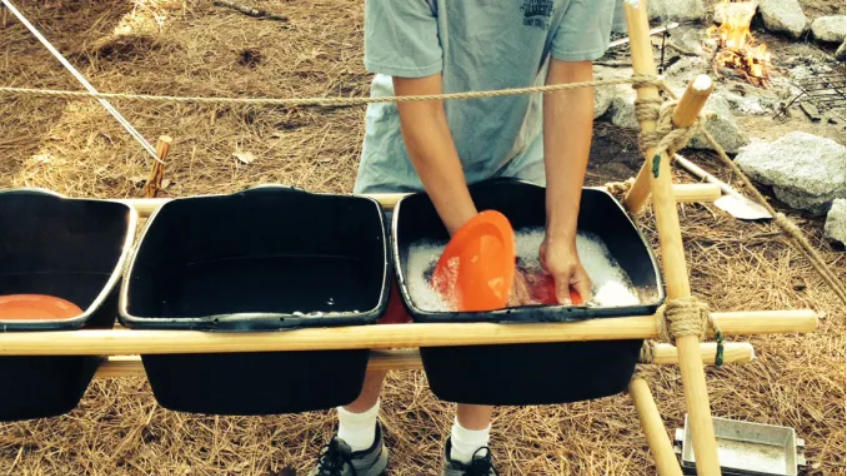
The Scout method of washing dishes requires three (or four) washtubs.
1. Filled with warm water and soap (use sparingly) to wash the dishes. Preferably, use biodegradable dishwashing soap.
2. Filled with hot water to rinse the dishes, removing all soap. Use tongs to dip the dishes into the hot water.
3. Filled with cool water and the appropriate number of Steramine Tablets or amount of bleach (read labels and use correct type!)
Some Troops will have a 4th tub at the beginning of the line to dump food into. Otherwise, a trash bag is acceptable for this purpose.
When finished, hang the dishes (if possible) to dry or use a towel to dry thoroughly and put away. Dispose of soapy wash water 200 feet from any water sources. Filter out food particles, and put those in a plastic bag to throw away. Then spread the water over a wide area.
Below is an image demonstrating the three tub method from the Boy Scout Handbook page 308.
Explain the importance of eating together as a patrol.
Sharing meals is more than just about food; it’s an opportunity to strengthen community and teamwork within your patrol.
Eating as a group helps develop a supportive, connected patrol. It makes the camping experience more enjoyable and teaches Scouts the value of teamwork and friendship.
Remember those knots we learned when earning our Scout Rank? Now it's time to put them to practical use.
Demonstrate a practical use of the square knot.
The square knot (also called a reef knot) is a simple and reliable knot used for joining two ropes of equal size. Some practical uses include:
Caution: The square knot is not reliable for load-bearing or critical applications, as it can slip under strain. For safety-critical uses, choose more secure knots.
Demonstrate a practical use of two half-hitches.
The two half hitches knot is a simple and versatile knot commonly used for securing a rope to a post, pole, or ring. Some practical uses include:
It's a strong and reliable knot that tightens under load but can be untied easily when needed.
Demonstrate a practical use of the taut-line hitch.
The taut-line hitch is an adjustable knot commonly used for tightening and securing a line under tension. It’s particularly useful when you need a knot that can slide and adjust but also hold firm under load. Here are some practical uses:
Camping & Outdoor Uses
The taut-line hitch is a great adjustable knot that holds well under tension but can be loosened or tightened as needed. It’s a must-know knot for campers, sailors, and anyone who needs a reliable, adjustable fastening.
Demonstrate proper care, sharpening, and use of the knife, saw, and ax. Describe when each should be used.
For the Tenderfoot rank, it’s important to know how to care for and use these tools safely and effectively. Proper maintenance and correct use of a knife, saw, and ax are essential skills in Scouting.
A Scout who completes the requirements for the Totin’ Chip certification shows that he or she has the knowledge and skills to safely handle wood tools, such as an ax, hatchet, pocketknife, or hand saw.
The Scout must show their Scout leader, or someone designated by their leader, that the Scout understands their responsibility to do the following:
The Scout’s “Totin’ Rights” can be taken away if they fail in their responsibility.
Using these tools properly helps you complete tasks safely and efficiently. For more details on tool safety, check out the Totin’ Chip Certification at Totin’ Chip Certification.
Understanding when and how to use each tool is an important part of being prepared and responsible in the outdoors.
We need your consent to load the translations
We use a third-party service to translate the website content that may collect data about your activity. Please review the details in the privacy policy and accept the service to view the translations.